
What is an RPV Filling Connector and How Does It Work?
When selecting a gas cylinder connector, most applications involve taking gas from a cylinder and supplying it safely to downstream equipment. However, some applications require gas to travel in the opposite direction – into the cylinder.
This is where specialist RPV filling connectors are required.
Designed for use with compatible cylinder valves incorporating a Residual Pressure Valve (RPV), these connectors allow the residual pressure mechanism to be deliberately opened during cylinder filling, venting and evacuation.
But why is residual pressure retained in the first place, and why is a specialist connector needed to overcome it?
What is a Residual Pressure Valve?
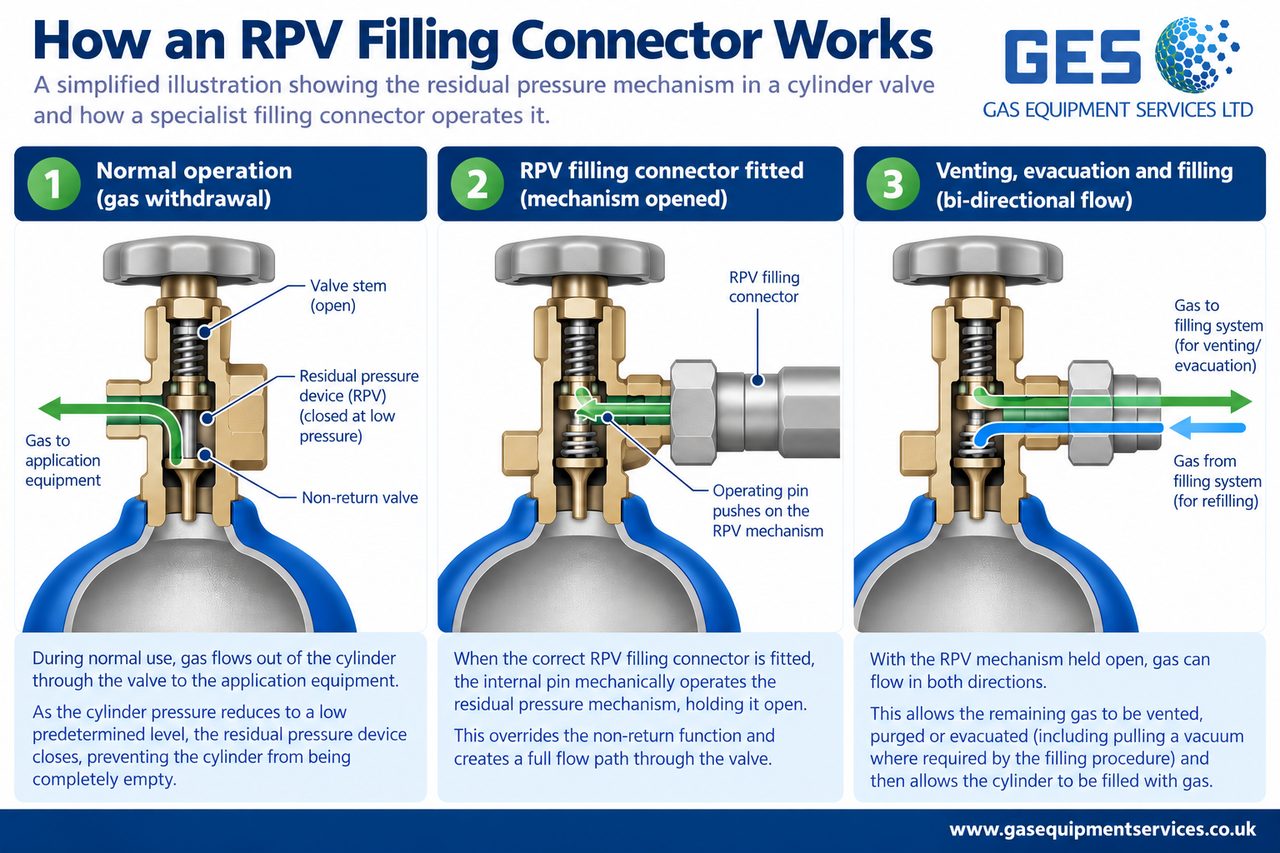
A Residual Pressure Valve, commonly referred to as an RPV, is a cylinder valve incorporating a non-return valve mechanism designed to maintain a small amount of positive pressure inside the gas cylinder.
With a conventional cylinder valve, continued gas withdrawal can eventually reduce the cylinder pressure towards atmospheric pressure. An RPV is designed to close the gas pathway before this happens, leaving residual pressure within the cylinder.
Maintaining positive pressure helps protect the internal environment of the cylinder. If a cylinder is completely depressurised, there is a greater opportunity for atmospheric air, moisture and other contaminants to enter.
Keeping the cylinder positively pressurised can therefore help to reduce contamination and protect the condition of the cylinder between fills. This can be particularly important where maintaining gas purity is a consideration.
Why is a Special Filling Connector Required?
The same feature that prevents unwanted material entering an RPV-equipped cylinder during normal use presents a challenge when the cylinder needs to be prepared and refilled.
Depending on the design of the residual pressure device, its non-return function can prevent gas from simply flowing back through the cylinder valve. It can also prevent the cylinder from being completely evacuated.
An RPV filling connector is specifically designed to overcome this.
Although externally it may look similar to a conventional gas cylinder connector, an RPV filling connector incorporates an additional feature – typically a pin or pusher within the connector.
When the correct connector is fitted to the cylinder valve, this pin mechanically operates the non-return function of the residual pressure mechanism inside the valve. This holds the internal mechanism open and allows gas to flow through a pathway that would otherwise be closed.
The cylinder can then be prepared for refilling in accordance with the appropriate filling procedure.
Venting, Purging and Pulling a Vacuum
Depending on the gas, cylinder and filling procedure, preparing a cylinder for its next fill may involve venting, purging or evacuation.
Where evacuation is required, a vacuum can be applied to remove the remaining gas from inside the cylinder.
An RPV would ordinarily prevent this because its purpose is to close before the cylinder is completely depressurised. By mechanically holding the residual pressure mechanism open, the specialist filling connector allows the cylinder pressure to be reduced below the normal RPV closing point and, where required by the filling procedure, allows a vacuum to be pulled.
Once the preparation process has been completed, the same open flow path can allow the cylinder to be filled with gas.
The filling connector therefore performs a very different role from the standard cylinder connectors commonly used to withdraw gas from a cylinder.
Why is the Correct RPV Filling Connector Important?
Selecting an RPV filling connector isn’t simply a case of identifying the thread on the cylinder valve.
The internal operating mechanism also needs to be compatible.
The position and required movement of the residual pressure mechanism can vary between cylinder valve designs. As a result, the dimensions and configuration of the pin within the filling connector are important.
A pin that does not operate the mechanism correctly may fail to fully open the required flow path. An incorrect connector could also potentially damage components within the cylinder valve.
RPV filling connectors should therefore be correctly matched to the particular cylinder valve and residual pressure device with which they are intended to operate.
This is one reason why an RPV filling connector shouldn’t be assumed to be universal simply because its connection appears to fit the cylinder valve.
Different Types of RPV Filling Connector
RPV filling connectors are available in a variety of configurations to suit different cylinder valves and filling systems.
Depending on the design, the operating pin may be fixed or movable, and connectors can be designed around different national and international cylinder valve connections.
The connection at the opposite end of the RPV filling connector also needs consideration, as this must integrate correctly with the filling or evacuation system.
Materials, seals, gas compatibility and operating pressure are also important factors when specifying any equipment used within a high-pressure gas system.
What Information is Needed When Selecting an RPV Filling Connector?
Correct identification of the cylinder valve is particularly important when sourcing an RPV filling connector.
Useful information may include:
- Gas or gas mixture
- Cylinder valve manufacturer and model
- Cylinder valve outlet connection
- Type of residual pressure device
- Required filling pressure
- Filling system or manifold connection
- Materials and seal requirements
- Details of the existing filling connector, where one is being replaced
Photographs, drawings or part numbers from the existing cylinder valve can also be extremely useful when identifying the correct equipment.
RPV Filling Connectors from GES
RPV filling connectors are a specialist area of gas control equipment, and selecting the correct product requires more information than simply matching a cylinder connection.
At GES Gas Equipment Services Ltd, we can help identify and source RPV filling connectors for a range of cylinder valve and filling applications.
Our bespoke sourcing service is particularly useful where a connector is difficult to identify, an existing component needs replacing or a less common configuration is required.
If you’re looking for an RPV filling connector, send us the details of your cylinder valve, gas and application and we’ll be happy to help identify a suitable solution.
Need help sourcing an RPV filling connector? Contact GES Gas Equipment Services Ltd for advice.

About the Author
Jennifer Hynes is the Director and Sales Manager at GES Gas Equipment Services Ltd. Experienced in the gas handling industry, she is passionate about helping customers find safe, reliable, and cost-effective solutions for their gas equipment needs.