
High-Pressure Stainless Steel Flexible Hoses: Everything You Need to Know
High-pressure flexible hoses play an important role in the safe and reliable transfer of gases from gas cylinders and other high-pressure sources into gas control systems.
In this article, we take a closer look at our high-pressure stainless steel flexible hoses: what they are, their key features and benefits, installation and maintenance considerations, when they should be replaced, and the options available from GES Gas Equipment Services Ltd.
What is a high-pressure stainless steel flexible hose?
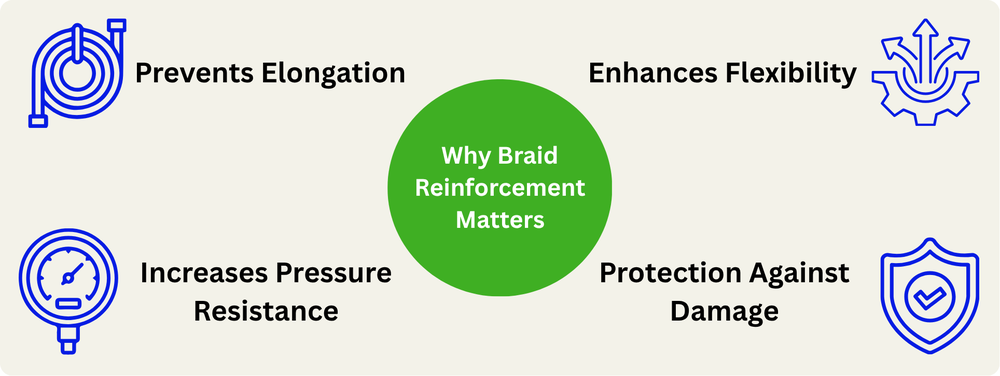
Our high-pressure flexible hoses are suitable for technical and speciality gases up to grade/purity 6.0. Manufactured from high-quality 316L corrugated stainless steel with stainless steel braiding, they are designed to combine flexibility with excellent pressure resistance and mechanical protection.
The corrugated construction allows the hose to flex, expand and contract while maintaining its integrity under pressure. This flexibility can make stainless steel hoses particularly useful in applications where rigid pipework may be less practical, allowing easier installation and accommodating movement, cylinder height variations or changes within the gas system.
Our hoses are also supplied with anti-kink springs and anti-whip restraints, helping to protect the hose and limit uncontrolled movement in the event of accidental disconnection.
Designed for demanding high-pressure applications
The vast majority of cylinders supplied in the UK have a fill pressure between 200 Barg to 300 Barg. High-pressure gas applications require equipment that can provide dependable performance under demanding conditions.
Our stainless steel flexible hoses are manufactured in accordance with relevant professional standards, including EN ISO 21969, ISO 10380 and EN ISO 23208, and are suitable for a maximum operating pressure of up to 320 Barg, depending on the hose specification and application and have a 1,280 Barg burst pressure.
They are also suitable for a wide temperature range, from -196°C to +550°C, making stainless steel hose assemblies suitable for many demanding industrial and speciality gas applications.
Installation and maintenance
Correct installation and ongoing inspection are essential to maximise the service life and safe operation of any high-pressure flexible hose.
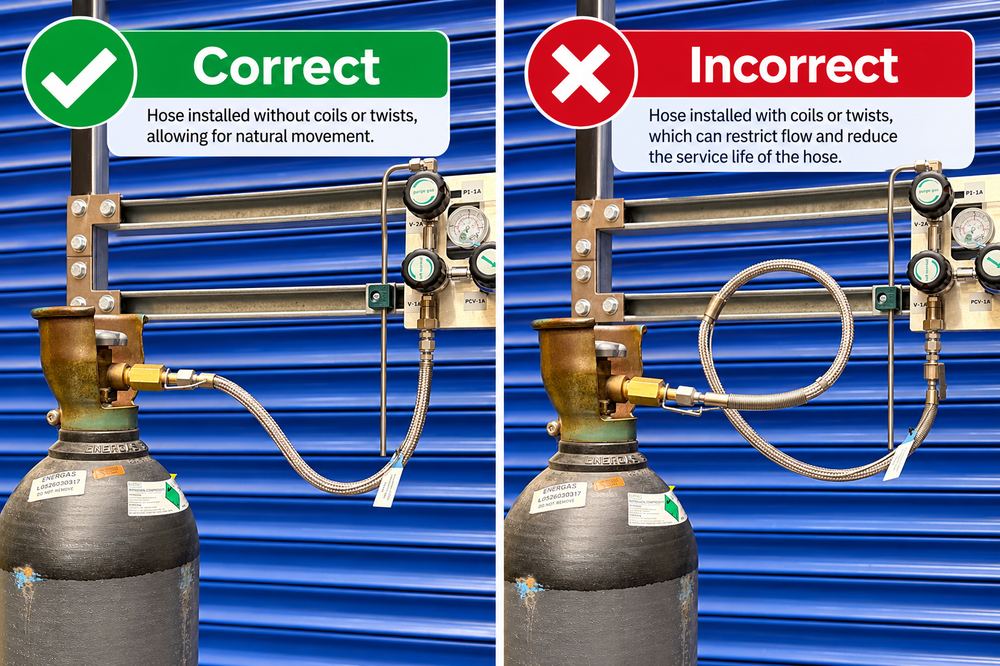
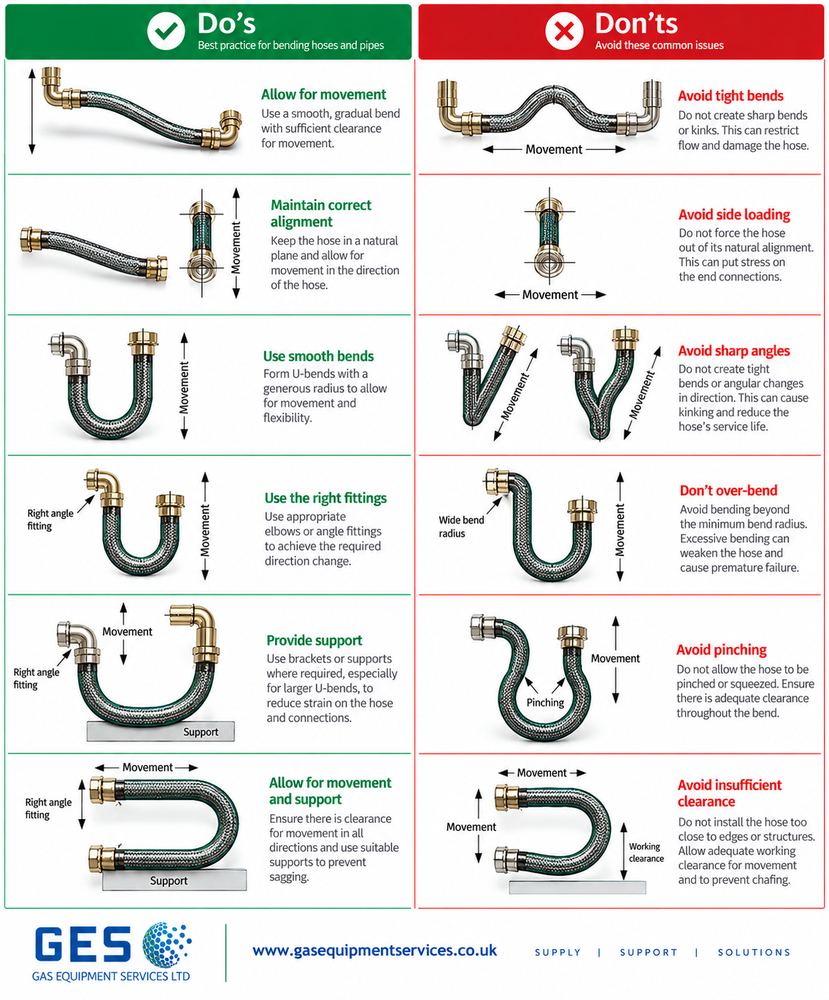
Installation and maintenance should always be carried out by an authorised, suitably trained technician and in accordance with the manufacturer’s instructions. The hose should be positioned correctly, avoiding excessive bending, twisting, tension or other stresses which could lead to mechanical damage leading to leaks and potentially a burst hose.
Where appropriate, hoses should be installed in a natural ‘U’ shape, allowing sufficient movement without placing unnecessary stress on the hose or its connections.
Hoses should also be protected from chemicals, corrosive substances and environmental conditions that could degrade the hose or its components. In addition to scheduled formal inspections, we recommend visually checking the hose before use.
What should you look for when inspecting a high-pressure hose?
Before use, check the hose assembly for:
- Damage to the braiding – including fraying, broken strands, excessive wear or bulging of the outer protective sleeve, if fitted.
- Deformation – look for twisting, kinking, denting, flattening or evidence that the hose has been subjected to excessive torque.
- Signs of leakage – check the hose and connections for evidence of escaping gas using a suitable leak detection fluid, such as Snoop. Do not use soapy water especially on corrosive or high purity gas systems.
- Corrosion – look for residue, pitting or corrosion spots caused by environmental contaminants.
- Incorrect bend radius – check that the hose has not been over-bent and remains within the manufacturer’s recommended minimum bend radius.
If there is any doubt about the condition or suitability of a hose, it should be taken out of service and assessed by a suitably qualified person.
High-pressure flexible hoses should also be replaced in accordance with the manufacturer’s recommended service life (every 5 years) and the requirements of the particular installation.
Good quality high-pressure hoses are marked with the manufactured date, the five year period can commence from the date of installation if authorised by a competent person.
High-pressure flexible hoses from GES
At GES Gas Equipment Services Ltd, our stainless steel high-pressure hoses are supplied specially cleaned and free from oil, grease and particles for oxygen service as standard.
Both ends of the hose feature ¼” NPT female ports, giving us the flexibility to assemble the hose with connectors and adaptors from our extensive range to suit your application.
Standard hose lengths include:
1 metre | 2 metres | 3 metres | 5 metres
Other lengths can also be sourced where required.
This means we can tailor the hose length, cylinder connection and fitting combination to your individual requirements. The completed hose assembly can then be tested before despatch, providing a convenient, ready-to-install solution.
GES Gas Equipment Services can also supply cylinder mounted pressure regulators or wall mounted gas manifolds.
Looking for a different type of gas hose?
Stainless steel braided hoses are just one of the options available from GES. We also stock a selection of industrial flexible hoses, including polyamide, polymeric elastomer, PTFE inner tube, plated-steel braided and polyurethane pricked protective sleeve options, together with a range of Stainless Steel pigtails and coils for gas control applications.
Choosing the correct hose depends on several factors, including the gas being used, operating pressure, required length, connections and the wider system design.
If you’re unsure which hose or connection is right for your application, please get in touch. Our team will be happy to help identify the most suitable solution for your requirements.

About the Author
Jennifer Hynes is the Director and Sales Manager at GES Gas Equipment Services Ltd. Experienced in the gas handling industry, she is passionate about helping customers find safe, reliable, and cost-effective solutions for their gas equipment needs.